Register now

To access the site, please provide the required information to verify that you are a Canadian healthcare professional and create an account. Once validated, this account can be used to log in to all myAstraZeneca websites for Canadian healthcare professionals. Please use the first and last name registered with your professional college.

PACIFIC Trial OS Data

Understanding IMFINZI treatment for your patients with non-small cell lung cancer (NSCLC)

IMFINZI is indicated for the treatment of patients with locally advanced, unresectable, Stage III non-small cell lung cancer (NSCLC) whose disease has not progressed following platinum-based chemoradiation therapy.1

Be IN the know with IMFINZI’s PACIFIC OS data

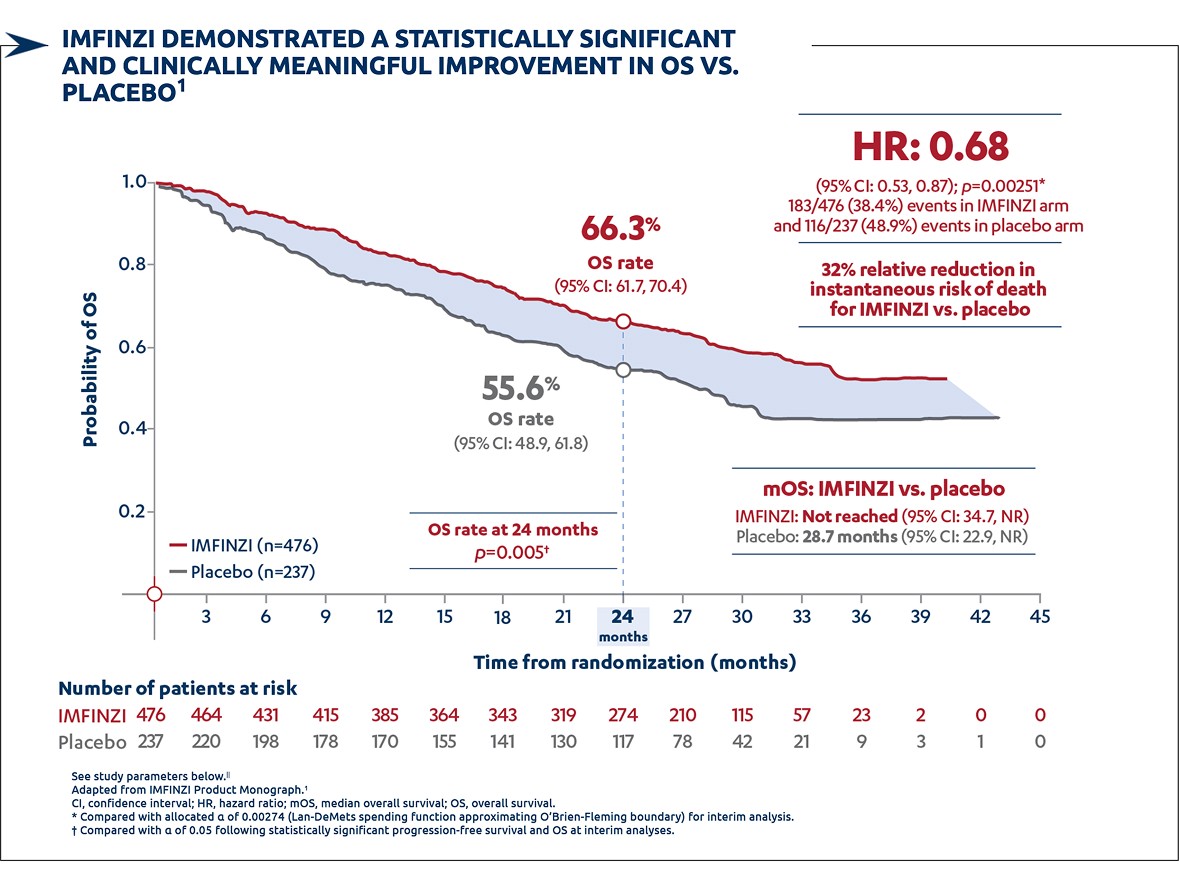
PACIFIC: Primary OS analysis

(full analysis set; median duration of follow-up 25.5 [0.2-43.1] months [all patients])1,2*

CRT, chemoradiation therapy; NSCLC, non-small cell lung cancer.

‡ Comparative clinical significance is unknown.

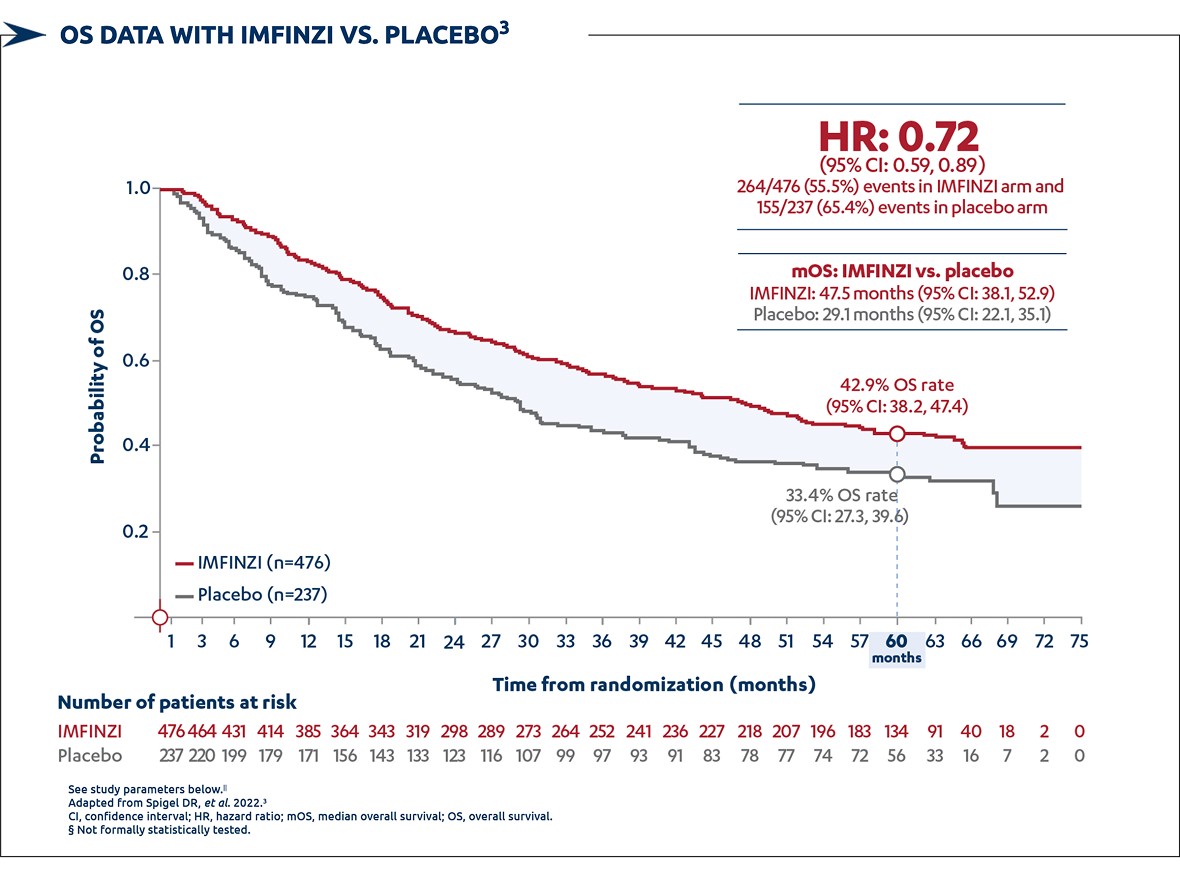
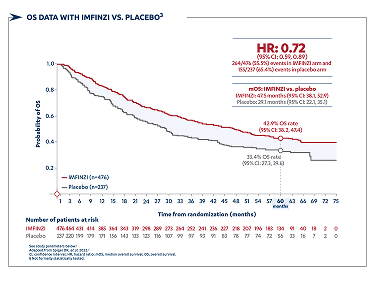
PACIFIC: 5-year updated OS analysis

(planned exploratory analysis; median duration of follow-up of 34.2 [0.2–74.7] months [all patients], 61.6 [0.4–74.7] months [censored patients])3§

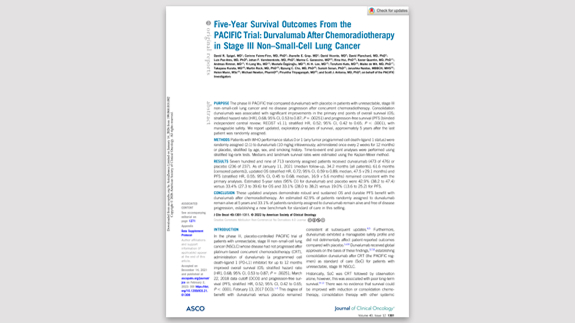
Click here to view the full study and learn more. This link redirects you to a website intended for the general public.

Consider IMFINZI: The only immunotherapy available for the treatment of patients with locally advanced, stage III, unresectable NSCLC without disease progression following platinum-based CRT.‡

‖ PACIFIC was a randomized, double-blind, placebo-controlled, multicentre Phase III study comparing IMFINZI vs. placebo in patients with locally advanced, Stage III, unresectable NSCLC with no disease progression after platinum-based CRT. Patients with World Health Organization performance status 0 or 1 (any tumour programmed cell death-ligand 1 status) were randomly assigned (2:1) to IMFINZI (10 mg/kg IV Q2W for 12 months) or placebo, stratified by age, sex, and smoking history. Time-to-event end point analyses were performed using stratified log-rank tests. Medians and landmark survival rates were estimated using the Kaplan-Meier method. The primary analyses of OS and progression-free survival (RECIST v1.1; assessed by blinded independent central review [BICR]) with IMFINZI vs. placebo was updated in the intent-to-treat population approximately 5 years after the last patient was randomized.3

Overall, 34 of 476 (7.1%) patients in the durvalumab arm received retreatment. Retreatment is not recommended. The recommended dose of IMFINZI is 10 mg/kg Q2W or 1,500 mg Q4W, which should continue for one year or until disease progression or unacceptable toxicity.1,3

CRT, chemoradiation therapy; OS, overall survival; NSCLC, non-small cell lung cancer; Q2W, every other week; Q4W, every 4 weeks.

References:

  1. IMFINZI Product Monograph. AstraZeneca Canada Inc. February 20, 2026.
  2. Antonia SJ, et al. Overall Survival with Durvalumab after chemoradiotherapy in Stage III NSCLC. N Engl J Med. 2018;379(24):2342-2350.
  3. Spigel DR, et al. Five-Year Survival Outcomes from the PACIFIC Trial: Durvalumab After Chemoradiotherapy in Stage III Non-Small-Cell Lung Cancer. J Clin Oncol. 2022;40(12):1301-1311.